

Selection of beautiful long-arm wall lights

Discover the timeless elegance of wall-mounted swing-arm lamps — from Charlotte Perriand’s iconic Potence Pivotante to Paolo Rizzatto’s Flos 265, Serge Mouille’s sculptural dual-arm design, and Jean Prouvé’s minimalist Lampe Potence.
Explore how these masterpieces blend function, form, and modern design heritage.

in your arms - figurative painting by Bodasca
arm wall lamp by Serge Mouille
Since the mid-20th century, wall lights with articulated or swiveling arms have been design objects in their own right, combining aesthetics, modularity, and precise use of light.
Far more than just light sources, they embody formal and technical innovation: the arm allows for directing the light, creating mood-generating zones, or establishing a dialogue between architecture, furniture, and lighting fixtures.
In a contemporary interior, they offer invaluable flexibility: a long arm can illuminate a reading nook, an adjustable head allows for directing a beam towards a painting or shelf, and the design becomes a major decorative element.
At the heart of this history, several models have left their mark on the collective imagination—each embodying a particular vision of the "function/aesthetics" relationship. We explore them below.
Wall lights with arms: elegance, functionality, and the evolution of design
Charlotte Perriand's "Potence Pivotante"
In 1938, Charlotte Perriand designed the wall lamp known as the "Potence Pivotante" (later produced by Nemo Lighting), which is said to have been inspired by the boom of a sailboat.
This creation is characterized by a tubular arm fixed to the wall that can pivot through an angle close to 180°, providing adjustable and adaptable lighting. It consists of two metal sections joined together (in an inverted L shape) to carry the electrical wire from the switch to the bulb.
The formal appeal is multifaceted: firstly, Perriand favored a minimalist, almost industrial aesthetic, where the light fixture is not "hidden" but rather prominently displayed. Secondly, the pivoting arm allows for versatile use—as accent lighting, a desk lamp, or a living room wall lamp. This duality between visual simplicity and technical sophistication makes the gallows an emblem of modern design. The externally screwed wire, the tubular assembly, and the long arm demonstrate a pragmatic sensibility combined with a strong aesthetic dimension.

The "Potence" Lamp by Jean Prouvé
Jean Prouvé, a visionary architect, engineer, and designer, conceived the "Potence" wall lamp in the 1940s.
Originally designed for his own home, this lamp consists of a tubular steel bar that pivots on a wall-mounted axis, often equipped with a handle for easy operation. Its aesthetic is industrial, minimalist, and expressive: only the bulb is attached to the end of the arm.
The "Potence" is distinguished by its economical use of materials, its formal purity, and the functional efficiency of its long, adjustable arm. It heralded the advent of flexible, off-center lighting, adaptable to evolving living spaces. Becoming a widely produced icon, it demonstrates the ability of wall lighting to become a work of design.

Serge Mouille's Two-Arm Wall Lamp
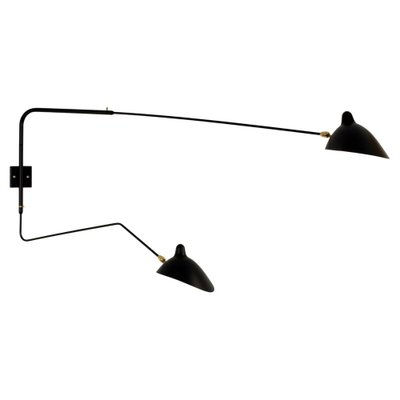
In the 1950s, Serge Mouille produced lighting fixtures that combined metal craftsmanship with modern design. Among his iconic creations is the "2 Straight Arms" (or "2 Pivoting Arms, One Curved") wall lamp, designed in 1954.
It consists of a wall bracket and two articulated arms, allowing for a wide range of light direction. The materials are true to his signature style: a black painted steel stem, black lacquered aluminum reflectors with a white interior, and brass ball joints.
This model embodies Mouille's approach: making the structure visible, highlighting the metal, and giving light a mechanical yet elegant gesture. The articulated arm thus becomes an element of visual composition as well as a functional one. Even today, this wall lamp is produced faithfully to its original form, underscoring its status as a design classic.
The “265” Wall Lamp by Paolo Rizzatto
In the 1970s, Paolo Rizzatto designed the “265” wall lamp for Flos in 1973.
This light fixture features a pivoting and adjustable arm, an adjustable reflector, and a conical cast iron counterweight: a true lever system designed to enhance the light.
The 265 is a typical example of functionalist design: the arm extends to direct the beam, the weight provides balance, and the overall design is understated yet highly adaptable. Rizzatto himself emphasizes this principle, referring to the use of color to define a light fixture and its visual role.
In a context where interior design is becoming more fluid, the 265 stands out as a discreet yet effective object. It can be placed in a bedroom, living room, or office, while remaining true to its pivoting motion.
Why are these wall lights with arms essential in interior design?
Adaptability and space saving: A pivoting arm allows you to illuminate different areas without needing multiple light fixtures.
Flexibility of use: Whether for home use (reading, ambiance, work) or professional settings, the wall light is adaptable.
Structured aesthetic: The arm becomes a strong visual element; whether tubular (Perriand), slender and balanced (Rizzatto), or articulated with two arms (Mouille), it contributes to the interior composition.
Directed light: Directed lighting improves functionality while reducing unnecessary light.
Heritage value: These models have become classics, sought after by design enthusiasts—giving the wall light with arms a collectible quality.
Integration into a contemporary interior
To make the most of a wall light with articulated arms:
Position it above a sofa, reading chair, or work surface.
Choose a model whose arm length corresponds to the depth of the furniture.
Plan for adjustable positioning to create different moods.
Check the style and finish: matte black metal (Mouille) for an industrial look, tubular steel (Perriand) for a clean, modern feel, or a slender lacquered arm (Rizzatto) for a touch of lightness.
Consider the scale: you need a sufficiently clear wall to allow the arm to extend.
Wall lights with articulated arms are no longer just lighting accessories: they embody the interface between architecture, light, and design.
The designs of Charlotte Perriand, Paolo Rizzatto, Serge Mouille, and Jean Prouvé are perfect examples—each in their own way translated function into form, technique into aesthetics. Integrated into a contemporary interior, they bring control, elegance, and sensitivity.
Discover them, choose them according to the space, the intended use, and the atmosphere you wish to create in your room.


Comments