

Eero Saarinen: Visionary Architect and Designer of the Tulip Chair


Eero Saarinen was more than an architect — he was a sculptor of space, form, and emotion. With his signature blend of elegance and innovation, Saarinen reshaped modern design through creations that remain as striking today as when they first appeared. From the graceful curves of the Tulip Chair to the soaring architecture of the TWA Terminal, his work continues to inspire designers, artists, and dreamers around the world.
Who Was Eero Saarinen?
Born August 20, 1910, in Kirkkonummi, Finland, Eero Saarinen was a Finnish-born American architect and industrial designer who left an indelible imprint on mid-20th-century architecture and furniture design.
He was the son of the celebrated Finnish architect Eliel Saarinen and textile artist Loja Gesellius, and he moved to the United States in 1923 with his family, where they settled in Michigan.
Saarinen trained in sculpture in Paris at the Académie de la Grande Chaumière before studying architecture at Yale (1931–1934). He also worked at Cranbrook, apprenticing under his father’s influence, where he developed his fascination with organic form and sculptural architecture. In his relatively short career, Saarinen established a reputation for pushing the boundaries of structural engineering, material innovation, and aesthetic boldness.
Tragically, Eero Saarinen died at just 51 years old (September 1, 1961), but by then he had already completed numerous iconic projects and left a legacy that continues to shape modern design.
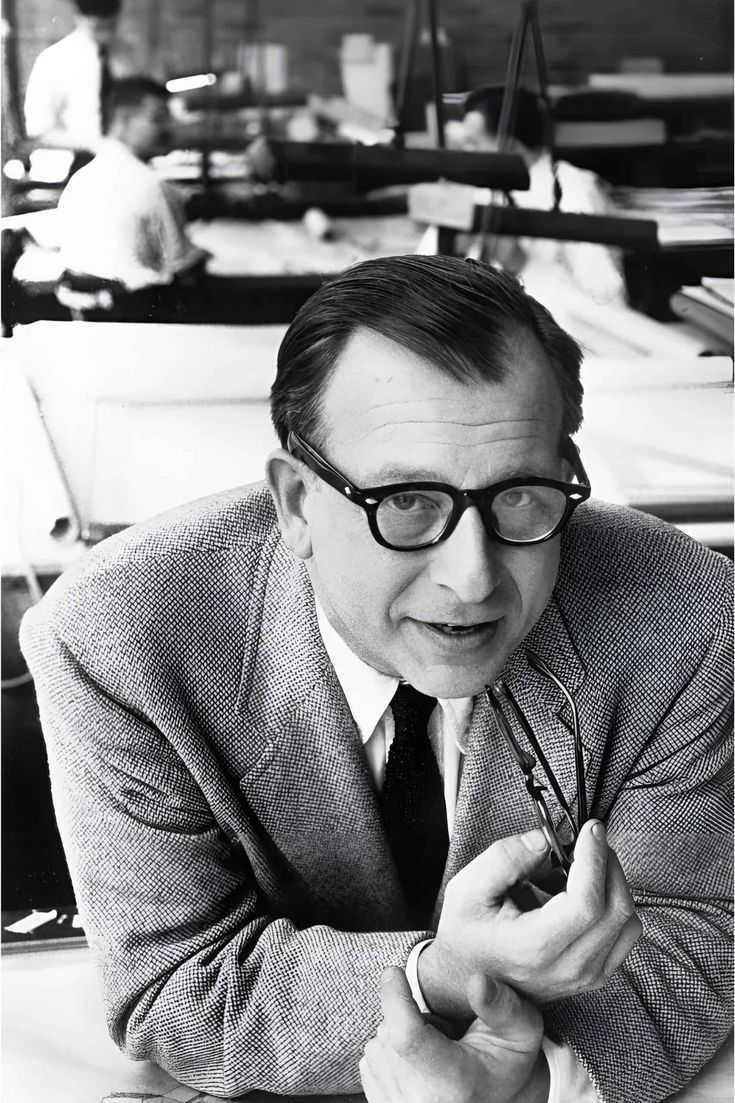
Why He Is Renowned?
Saarinen is celebrated for his ability to blend sculptural form and functional architecture, bridging the gap between engineered structure and expressive aesthetic. Rather than adhere to rigid stylistic schools, he often pursued designs tailored to each context — whether corporate, civic, or domestic — resulting in buildings that feel both futuristic and grounded.
His work marked a shift from rigid, boxy modernism to more fluid, expressive architectures.
Saarinen was awarded, posthumously, the AIA Gold Medal in 1962.
He remains influential because of his holistic view — seeing architecture, furniture, and interior as a continuum, and designing both major buildings and furniture pieces with a unified language of curves and purity.

Signature Works & Products
Architectural Masterpieces
Some of Saarinen’s most celebrated architectural works include:
Gateway Arch, St. Louis — his stainless steel arch became an American icon.
TWA Flight Center, JFK Airport — a sweeping, organic terminal building that feels like movement made into concrete.
General Motors Technical Center in Michigan — a corporate campus embodying modular clarity and modernist aesthetics
Dulles International Airport terminal, and other corporate buildings and campus projects.
These projects demonstrate his ambition to fuse structure and sweep, to let architecture feel alive.

Furniture & Design Classics
Saarinen’s furniture designs are also legendary. Among his most notable:
Tulip Chair & Pedestal Collection (1955–56) — perhaps his most famous furniture design.
The Tulip Chair was part of his “Pedestal Group” for Knoll.
Saarinen’s goal was to eliminate the “slum of legs” under tables and chairs, unifying form into a single flowing shape.
It used molded fiberglass reinforced shell and cast aluminum pedestal base with Rilsan coating.
Versions exist with swivel or fixed base, and with upholstered seat cushions or full upholstery.
The Tulip Armchair is held in the MoMA collection.
Womb Chair and Grasshopper Armchair — expressing comfort, organic form, and interior intimacy.
These chairs and pieces reflect Saarinen's belief that furniture should match the elegance and coherence of architecture.

How to Integrate Tulip Chairs into a Contemporary Interior
Saarinen’s Tulip chairs are sculptural, minimal, and iconic — yet they can feel at home in a modern interior when integrated thoughtfully. Here’s how to do that:
Let the Form Speak The Tulip chair has a clean silhouette. Avoid cluttering around it. Place it where its curves can be appreciated — in a corner, next to a side table, or as dining chairs around a sleek, minimalist table.
Use a Neutral or Light Base The original chairs come in white or black shells, which pair beautifully with light floors (marble, pale wood) or neutral walls, so the shape and shadow stand out.
Textile Contrast If your interior is minimal, add contrast with cushion upholstery textures — wool, boucle, leather — that bring warmth without jeopardizing the sculptural purity.
Echo Curves Use soft, organic shapes elsewhere (a curved rug, rounded console, soft lighting) so the Tulip chair’s curves feel part of a whole. This supports visual harmony.
Position with Art or Statement PiecesThe chair is a design statement. Pair it with art or architectural lighting. In a living space, you might set it facing your artwork or near your wall to create a balanced focal zone.


Eero Saarinen stands as one of the great visionaries of modern design — bridging architecture and furniture with fluid, expressive forms. His architectural works like the Gateway Arch, TWA Flight Center, and GM Technical Center remain landmarks of modernism. In furniture, the Tulip chair is a design icon that expresses his philosophy of unifying form and function.
To bring Tulip chairs into a contemporary interior, allow them space, contrast them cleverly, and echo their curves in complementary design elements. When paired with striking contemporary artworks like Emerald Form or Verdant Stillness, they become part of a cohesive aesthetic dialogue — blending minimalism, organic form, and timeless elegance.

@la paire de chaises Tulipes , chez Debongout


Comments